Verdict Score: 8.5 / 10 ⭐
Editor’s Note: Our comprehensive review evaluates narrative pacing, directorial vision, visual storytelling, and audience impact. Below is our full in-depth analysis.
Ramanand Sagar’s Legacy vs. The ₹4000 Crore Cinematic Gamble
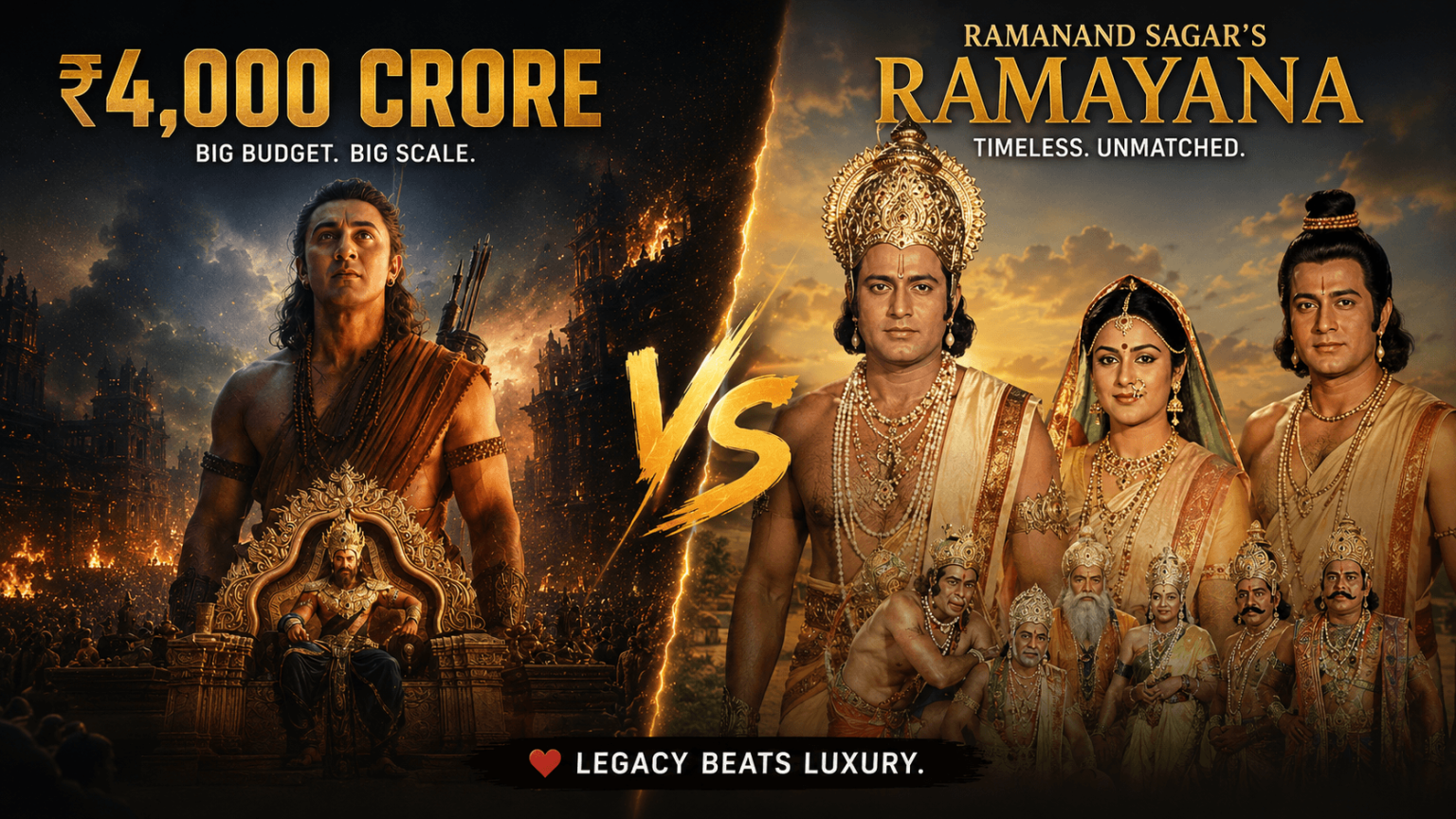
So on one side there is Ramanand Sagar’s Ramayan – whose sets were simple as per today’s standards, VFX were almost negligible and the budget was also limited as per the television standards of that time. But still it brought the entire country to a halt. The streets would become empty, people would sit in front of the TV with their shoes off. Not only a TV serial, a show but it became a cultural event for the whole of India which people remember even today.
And just on the other side of that comes the Rs 4000 crore Ramayana (Nitesh Tiwari’s Ramayana / Namit Malhotra)—India’s Biggest Cinematic Gamble, World’s Best Technology, Global VFX Studios, Massive Star Cast and everything that Ramanand Sagar never had. But the real question is that if the story of Ramayana is the same, can just Rs 4000 crores make it better? Or did Ramanand Sagar ji have something that could never be bought with money?
Content vs. Sacred Experience: The Art of Creating Faith
In this day and age where everything has become ‘content’, any film or show is overly optimized—algorithms, trends, tracking, first reaction, opening weekend, critical reception—everything turns out to be data on an Excel sheet and is considered essential to making a film. Whereas Ramanand Sagar was not doing that with his Ramayana. He was not trying to make content that was binge-worthy popcorn entertainment, which had to have something big in the first episode or else the audience would leave it. Because he was not trying, he was creating. He was creating an experience for people who consider him sacred.
After that, he created such a thing that people used to take off their shoes and slippers to see him, people used to worship his show, there were twenty people crowded around each TV, people used to close their shops early and come back. Television used to be a temple, and at that time production value was secondary because emotional value was everything.
CGI vs. Emotional Truth: Why Mythology Transcends VFX
In today’s time, technology has improved, but human emotions and their faith have not improved. Our human nature is still the same. That’s why in today’s ‘Avengers’ era, films just start judging themselves on this scale that “Better CGI = Better Films”. The truth is that it is not so at all. Ramayana has survived more than 2000 years, that too without CGI and VFX.
Because its real strength comes from its characters, morality, religion, sacrifice and emotional truth. Modern technology should amplify those feelings and emotions, but should never make the mistake of replacing those values.
Writing with Reverence: The Soul of Epic Storytelling
Do you know what makes a piece of art immortal in today’s spectacle-filled times? Reverence, belief—to believe in the truth that is being shown, which transcends you, me, any human being. That’s why in today’s Maasi, Baahubali, Marvel or cinematic universe trending audience, everything has to be bigger, bigger, louder and faster. But these things were never to happen in Ramayana. No one ever considers Ramayana as such a big film in which one is waiting for a big explosion in its emotional climax. not at all!
You wait to see how Lord Ram will leave Ayodhya, Bharat will refuse to sit on the throne, King Dasharatha will sacrifice his life in grief, how Maa Sita will cross the Lakshman Rekha, and how Bajrangbali will teach how to be a true devotee. To do all this you do not need Rs 4000 crore, for this you need – writing with reverence.
Ramanand Sagar also knew at that time that he was limited by his technology and resources, but he left no stone unturned in showing his devotion to the world.
The Cautionary Tale of Adipurush & Modern Misunderstandings
It is not that adaptations of Ramayana should not be made again and again, because I believe that every generation deserves to see its Ramayana in its own language. Before us, my father and his father saw their Ramayana, today I am going to see my Ramayana, and the generation coming before me should get their Ramayana. The issue is not about remaking at all, rather the issue is about misunderstanding what you are updating.
No one wants to modernize the soul of Ramayana, like Om Raut did with ‘Adipurush’. Modernization comes in the language and technique of cinema, not in the dignity of its characters. That is why Adipurush emerges as a warning that when you take modernization in the wrong direction and make your actor bigger than the film, where the scale of the film starts leaving the storytelling behind.
At first glance, people didn’t reject Adipurush just because of its CGI or VFX, they rejected because it took such strange creative choices in Ramayana that it couldn’t even connect with first-time viewers. The audience was never anti-modern, they were anti-holo. They recognize hollowness and falsehood—when the hero doesn’t work hard for his role, when filmmakers don’t take their story seriously, when the work seems to be more about money and entourage than honesty.
This is not limited only to filmmakers, every person who works in the field of art or passion, it is important for him to understand that the public should not be lied to. If you’re not perfect (which no one is), but you’re showing true passion for your work, people respect that passion. But not that half-hearted effort, where hard work is visible only in the budget and not in the intentions.
Where Money Actually Helps: Vision vs. Unlimited Budget
So can all these things actually help in earning Rs 4000 crore? Absolutely can! Not only for the cast, but better working conditions for the crew, better production design, action, costumes, VFX artists who stay up all night rendering the frames weeks before the release—their proper compensation, sound, music, scale, global outreach—money helps a lot. The problem is never money, the problem is money that has no vision behind it.
That is why Ramanand Sagar’s Ramayana becomes a golden standard. Not because ‘old is gold’, nor because there was a first-mover advantage. But because Ramanand Sagar had a vision. Every creative choice there was made only to serve the story—not for reaction to the trailer, not for opening weekend, not for international box office or critics. Just for the story, for Ramayana!
Ramanand Sagar’s biggest strength was not his small budget, but his clarity. He knew that he didn’t have to make Ramayan to impress the audience, he just had to do one thing—touch people’s hearts, and he did that.
Final Verdict: The Golden Standard for Nitesh Tiwari’s Ramayana
If Namit Malhotra and Nitesh Tiwari’s Ramayan remembers this same determination, it too could become a classic film. If it can forget its budget and understand its emotions and values, and shed the tag of ‘India’s Biggest Most Expensive Film’, then people will not only watch it but worship it. But if this thing is forgotten, then it will again become just a most expensive memory which will tell that – money can make the world, but legends are made only by conviction.